
Understanding Camp County Releases
A Camp County release ends one Sheriff’s Office booking episode. It does not always mean the person went home. Bond, sentence completion, or a court order can return someone to the community. A transfer can instead send the person to TDCJ, another county, a warrant holder, the United States Marshals Service, or ICE. The book-out record and receiving-agency field separate those paths.
Camp County publishes no official live roster or release archive. The Camp County Sheriff page directs custody questions to VINELink and gives the office contact. A released person may drop from an active result, while the booking sheet, court docket, or next custodian keeps the lasting evidence. Absence alone proves little. It can reflect transfer, out-of-county housing, a spelling mismatch, a sealed matter, or delayed data.
Camp County Release Types
The release notation determines the next search. Bond is release while the case continues, not an acquittal. Time served means credited custody ended. Parole is a prison release into supervision. Probation comes from a court and may occur without prison. Dismissal concerns a charge, but another cause or hold can keep the person confined.
| Type | Meaning | Next record |
|---|---|---|
| Bond | Release pending court action | Sheriff book-out and clerk docket |
| Time served | Credited county term ended | Release entry and judgment |
| Parole | TDCJ custody changed to supervision | TDCJ and Parole Division |
| Transfer | Camp custody ended; another custodian took control | Receiving county, TDCJ, USMS, or ICE |
| Discharge | Sentence or supervision ended in the stated context | Final TDCJ or court record |
- Detainer
- A basis for another agency to assume custody.
- Time served
- Credit satisfying the custodial term.
- Discharge
- The recorded end of a sentence or supervision duty.
Camp County Release Record Fields
No single Camp form is published as a universal release certificate. Ask for existing records and named fields. A narrow request reduces confusion between people with similar names and supplies a useful date range.
| Field | What it shows |
|---|---|
| Booking or cause number | Connects the person, booking, and case |
| Book-in and book-out times | Marks the local custody window |
| Release code and code key | States the agency’s release category |
| Bond notation | Shows bond activity, not final disposition |
| Receiving agency | Identifies a transfer |
| Booking photograph | Identifies the booking, subject to lawful limits |
A court file answers a different question. It can show bond, plea, dismissal, judgment, or sentence, yet omit the minute of physical release. Strong confirmation joins the Sheriff’s custody record with the proper clerk record.
Request Camp County Release Records
Camp has not published a jail-record form, local fee, promised turnaround, or retention period. Send a focused Texas Public Information Act request to the Sheriff and ask where current submissions are accepted.
- Give the full name, birth date if known, booking or cause number, and approximate dates.
- Request the booking sheet, book-in and book-out timestamps, release code and existing key, bond notation, receiving-agency entry, and booking photo.
- Ask for existing records under Texas Government Code Chapter 552, not explanations or a new report.
- Keep the response with the court record and any next-custodian result.
203 Tapp Street
Pittsburg, TX 75686
903-856-6651
Fax 903-856-3681
Call before visiting. Camp publishes no records-counter hours or entrance instructions. Texas law permits charges in some cases, but no local amount should be quoted until the office supplies an estimate.
Camp Release Records and Courts
Texas Government Code Chapter 552 governs public-information access and its exceptions. Juvenile, confidential, sealed, and expunged material needs care. Chapter 55A expunction depends on arrest, charge, disposition, and timing facts. Merely leaving jail is not enough.
Nondisclosure under Government Code Chapter 411 is not destruction. The Camp District Clerk handles felony records and provides an expunction resource. The County Clerk handles county-level records. A missing public result is a limit, not proof of guilt, innocence, release, or custody.
Find Camp County Released Inmates
Begin with the last known custodian. Camp’s missing public roster makes that classification vital. Use full identifiers and preserve the wording of each result.
- For a recent county event, search Texas VINELink and call the Camp Sheriff to separate community release, transfer, and out-of-county housing.
- For state prison, search TDCJ by TDCJ or SID number when known.
- Check the proper Camp court for bond, dismissal, judgment, sentence, or warrant activity.
- Use BOP for a federal sentence and ICE ODLS for an immigration handoff.
- When online data is missing, request the exact Camp or TDCJ record in writing.
Why did the name disappear? Live tools answer who is held now. They are not permanent archives. A name may vanish after release or transfer, so the book-out record and receiving-agency field matter more than a blank screen.
TDCJ Search for Camp Releases
The TDCJ inmate search applies after entry into Texas prison custody. It is not Camp’s jail log. A projected date is a calculation, and parole eligibility is only a review threshold. Neither proves physical release. An actual status, release history, or release-processing confirmation is stronger.
| Field | Use | Limit |
|---|---|---|
| Last name | Required start | Common names collide |
| First name | Narrows results | Variants differ |
| TDCJ number | Seven-digit identifier | TDCJ records only |
| SID number | State identity match | Must be exact |
| Gender or race | Further narrowing | Not an identity substitute |
The official form shows how Texas structures a state search.
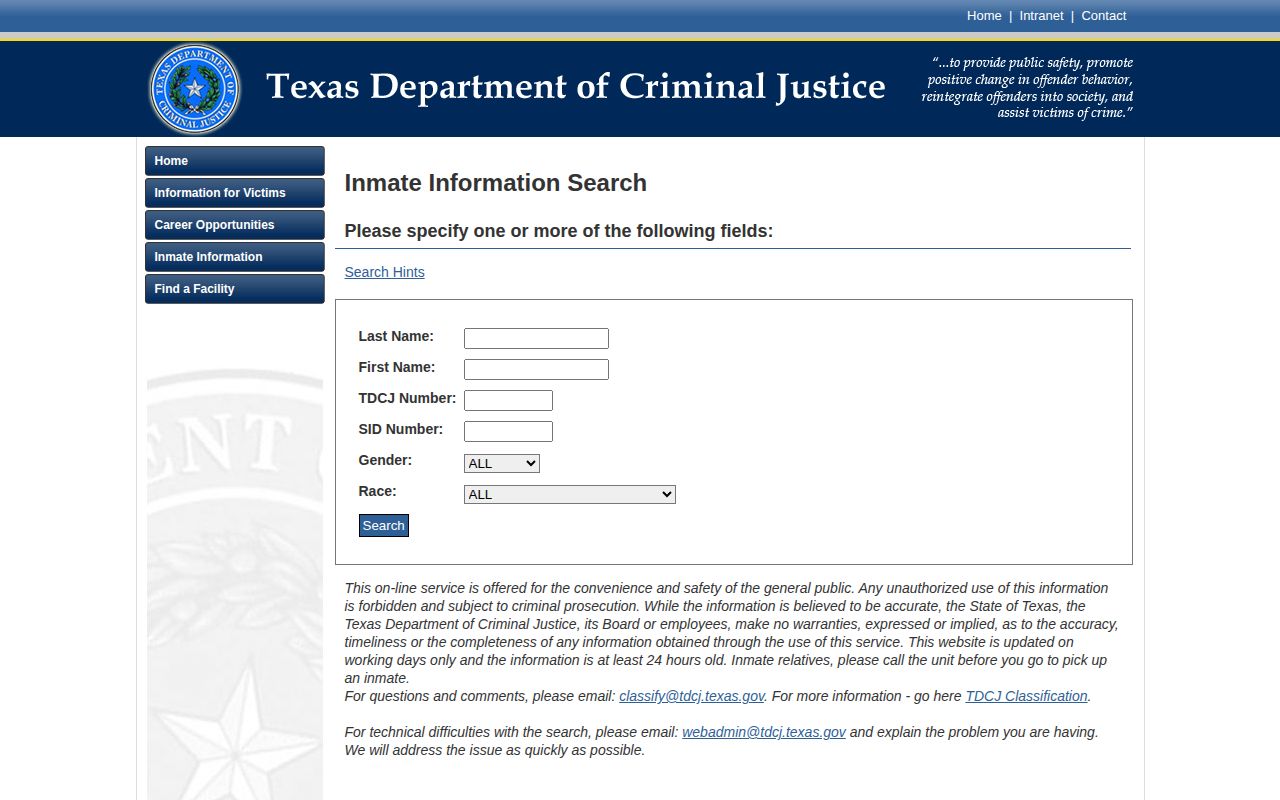
This channel matters only when Camp’s custody chain reaches TDCJ.
If the result is thin, email pia@tdcj.texas.gov with the full name and TDCJ number, or exact birth date when unknown. The free email service can provide incarceration history and projected-release information but no photographs. A formal TDCJ request can seek an existing release certificate, actual release or discharge date and type, incarceration history, and public time sheet.
Camp County Recent Release Limits
The Sheriff has no official 24-hour, 72-hour, daily, or date-range feed. VINELink reports events and supports alerts; it is not a complete archive of everyone released in a chosen window. For a recent event, search VINE, then call 903-856-6651 with the name, birth date if known, and booking range.
Ask whether the person is held for Camp, physically housed at Tapp Street or elsewhere, booked out, transferred, or released to the community. When exact time or code matters, request it in writing. The county budget confirms out-of-county housing as a category but does not name any person’s receiving jail.
Camp County Release Supervision
Parole follows release from TDCJ before a sentence fully ends. Probation, called community supervision in Texas, comes from a court and may occur without prison. Camp probation inquiries belong with Adult Probation. Camp parole cases route through the Mount Pleasant District Parole Office.
A favorable parole vote is not release proof. TDCJ must validate the plan, complete required programs, audit the record, prepare a certificate, and schedule release. Once release happens, the parole office can confirm the supervising office and permitted status information. Final discharge may occur later.
Camp Alerts and Federal Releases
VINELink is Camp’s county-endorsed event and alert path. TDCJ’s Integrated Victim Services System covers state-prison and parole events. A Camp bond release belongs to the county VINE chain. A prison release belongs to TDCJ, Parole Division, and IVSS.
The BOP locator can show a federal Release Date and RELEASED location for records generally after 1982. That does not prove the end of federal supervision or another hold. ICE ODLS accepts an A-number and country of birth, or exact name and country of birth. Search promptly because ICE retains released-person locator history for a limited period.
Camp Court Status After Release
A custody record and a case docket answer different questions. The jail records physical control. The court records the legal cause, orders, plea, disposition, and sentence. Someone may leave on bond while charges remain pending. A dismissal on one cause does not eliminate a hold on another. A judgment may explain the sentence without giving the book-out minute.
The official County Clerk search is the local starting point for county matters, while the District Clerk handles district and felony cases. Match the full name, birth date, cause number, court, and date range. Pair the docket with the Sheriff response when exact exit or transfer matters. This is the Camp-specific court interplay identified in the research, and it prevents a bond entry from being mistaken for a final disposition.
When Camp Jail Releases People
No official Camp source gives routine release times, weekend or holiday rules, a public exit door, family waiting area, property-return steps, or pickup instructions. The facility may operate all day, but that does not mean records service or public release processing is available at every hour. Court paperwork, bond acceptance, another hold, transportation, and the location of physical housing can all affect timing.
Call the Sheriff before traveling. Ask whether book-out is final, where the person is housed, which site will process the exit, whether property is ready, and whether a pickup location can be shared. If staff cannot estimate a time, wait for direct confirmation rather than treating a VINELink event as a promise that the person is already outside.
Camp Out-of-County Release Locations
Camp County’s adopted budget includes an out-of-county inmate-housing line. That establishes the practice as a county expense category, not the location of any named person. Someone may remain under Camp authority while another jail holds them physically. The web absence can therefore reflect placement rather than release.
Ask Camp personnel to name the responsible booking agency and physical custodian, then contact both. Camp may hold the booking and court link while the housing jail controls movement and final exit logistics. The record request should include any transfer field and receiving-agency entry. Never infer the receiving jail from a budget document or from proximity alone.
Camp Release Verification Channels
The fastest Camp inquiry is a phone call, but the best channel depends on what must be proved. Supply the person’s full name, birth date if known, and approximate booking date. Ask whether Camp remains the responsible agency, whether another jail houses the person, whether book-out is final, and whether the event was community release or transfer. A staff answer can confirm the present situation. A written record is better when the exact time, code, or receiving agency matters.
For an in-person request, go to 203 Tapp Street only after calling. Camp gives no public records hours, entrance directions, or property counter schedule. A detention facility operating around the clock does not imply that a records desk does the same. For a written request, identify the existing document and narrow the dates. Ask for records rather than asking staff to research or explain a case. Keep the office response, since a phone statement may not preserve the precise terminology.
For older events, pair the Sheriff response with the right clerk. County Clerk records cover county-level matters. District Clerk records cover district and felony cases. A court entry can explain why release was authorized, while the jail record establishes when local physical custody ended. If the two appear inconsistent, confirm the cause number and ask each originating office about its own record instead of guessing which entry is wrong.
Correcting TDCJ Release Data
A TDCJ projected date can change without being erroneous. New court credit, good-conduct time, disciplinary action, a detainer, parole action, or a corrected judgment may alter the calculation. Read the label and update date before raising a dispute. For a suspected state time-credit, transfer, or calculation error, TDCJ directs questions to Classification and Records at 936-437-6231 or classify@tdcj.texas.gov.
Identify the disputed field and attach the authoritative document, such as a judgment, amended judgment, or jail-credit order. Do not claim that a date is wrong simply because it moved. If the issue is access to an existing public record rather than a calculation, use the TDCJ Public Information Act channel. Operational correction and public-record access serve different purposes.
Camp Releases to ICE Custody
An immigration detainer can lead the Sheriff to notify ICE before a local release and coordinate a handoff under applicable authority. Camp may then record a book-out even though the person remains confined. This timing distinction matters. “Released by Camp” can describe a change of custodian rather than release into the community.
Ask whether the release code names ICE or another receiving agency. Then use ICE ODLS promptly because released-person results remain available only for a limited window. Keep the immigration custody result separate from the Camp booking record. One proves the county episode ended; the other explains what followed. The official ICE detainer explanation describes the federal process without establishing what happened in an individual case.
Where Camp Release Records Appear
Choose the channel by custody type and date. No search covers every system.
| System | Best use | Does not prove |
|---|---|---|
| Camp Sheriff and VINE | Recent county event | Permanent date-range archive |
| Camp courts | Bond, disposition, sentence | Exact physical exit |
| TDCJ | Texas prison status and history | Camp jail release alone |
| BOP | Federal custody and release | End of all holds |
| ICE ODLS | Recent immigration custody | Long-term history |
If all searches are blank, repeat identifiers and variants. Ask Camp about out-of-county housing, check the correct clerk, use TDCJ email for history, and decide whether federal or immigration custody applied. Multiple blank screens do not prove release.
Camp County Release Facility
Camp County Jail is the only confirmed detention facility in the county. The Sheriff operates it in Pittsburg. A person may return to the community or transfer to another custodian. No TDCJ prison, BOP institution, or ICE detention center was identified inside Camp County.
The exit point, property process, pickup area, daily timing, and local transportation support are not published. Call first. Ask where the person is physically housed, where final release will occur, and whether pickup is permitted. Do not apply statewide TDCJ clothing and bus-ticket practices to this county jail.