
Camp Projected vs Actual Release
“Projected Release Date” is a TDCJ field calculated under the sentence and Texas law. A scheduled release date appears later, after release processing has advanced, but TDCJ warns that it can still change through release day. An actual release or discharge entry records an event that occurred. These fields are not interchangeable. A parole eligibility date only marks when review may begin, while a Board vote may still be followed by plan checks, programs, an audit, certificate preparation, and scheduling.
A person held at Camp County Jail before trial normally has no computed release date. Bond acceptance, dismissal, a court order, or transfer can end the stay. Even after bond posts, another hold may prevent community release. For a county sentence, the judgment, jail credit, applied commutation, and final book-out record form the useful chain.
Find Camp County Projected Dates
Choose the search channel by custody type. The TDCJ search does not cover a person whose only stay was in the Camp jail. Conversely, a Camp book-out cannot supply the later state-prison calculation after a transfer.
- Confirm whether the person is pretrial, serving a Camp jail sentence, transferred to TDCJ, or already released under supervision.
- For TDCJ, search by TDCJ or SID number when possible. Otherwise use last name, first name, and the form's narrowing fields.
- Open the matched detail. Copy the exact labels for projected release, parole eligibility, scheduled release, maximum sentence, status, and location.
- If the live record is thin, email pia@tdcj.texas.gov with the full name and seven-digit TDCJ number. Without that number, supply exact birth date or approximate age and county of conviction.
- For Camp Jail, call 903-856-6651 and ask for the sentence basis, jail credit, calculated date, holds, transfer status, and final book-out.
The TDCJ offender search is the state-prison starting point.
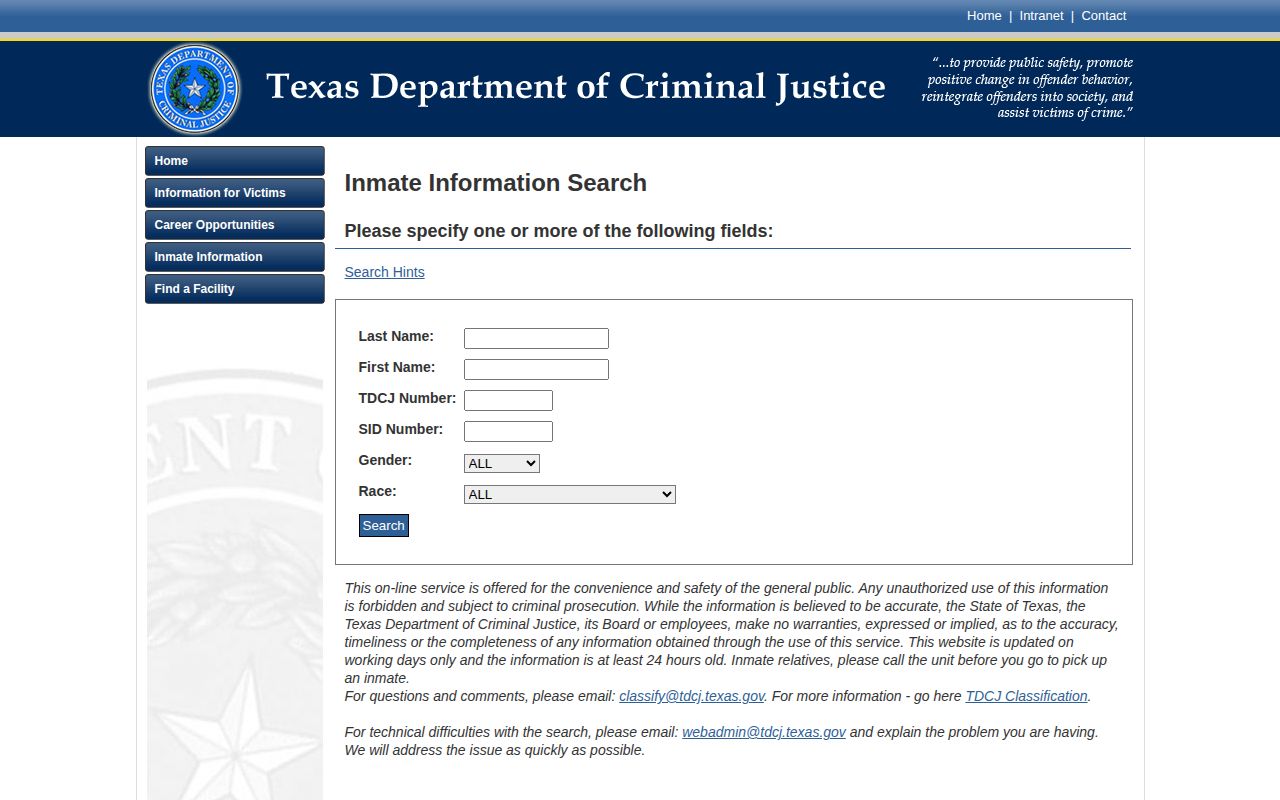
The captured form shows why a state identifier is stronger than a name-only match for a Camp County release calculation.
Texas Has No General 85% Rule
Texas does not impose a blanket rule that every state prisoner serves about 85 percent. Government Code Section 508.145 instead sets rules based on offense, offense date, sentence, and other findings. Many eligible sentences use a statutory combination of calendar time and good-conduct time for parole eligibility. For listed serious offenses and certain deadly-weapon findings, the rule generally requires actual calendar time equal to one-half of the sentence or 30 years, whichever is less, before parole eligibility. Good-conduct time does not shorten that threshold. Other offenses and life terms have special rules.
Eligibility still is not release. The Board may deny parole and set another review. Section 508.149 makes some people ineligible for mandatory supervision. Others reach maximum expiration without parole. Record parole eligibility, projected release, mandatory-supervision action, and maximum or discharge date as separate facts.
- Calendar time
- Actual days served.
- Good-conduct time
- TDCJ credit used only where the governing law permits.
- Parole eligibility
- The earliest statutory point for review, not a release date.
- Maximum expiration
- The sentence endpoint after the controlling calculation.
Why Camp Release Dates Change
A changed date is not proof that the earlier entry was false. TDCJ recalculates when an authoritative input changes. Ask Classification and Records about a suspected state calculation error at 936-437-6231 or classify@tdcj.texas.gov, and identify the disputed field with the judgment or jail-credit order.
| Factor | Possible effect | Best verification |
|---|---|---|
| Sentence or jail-credit correction | Moves the computed date | Judgment or amended order |
| Concurrent or consecutive terms | Changes how terms combine | Court and TDCJ time records |
| Good-time earning or forfeiture | Changes eligible calculations | Public time sheet |
| Parole or supervision action | Adds review, denial, or conditions | Board code and release processing |
| New case, detainer, or hold | May prevent community release | Custodian and receiving agency |
| Administrative audit | Corrects data before release | TDCJ Classification and Records |
Confirm a Camp Release Date
For a Camp Jail event, use the VINELink Check and the Camp County Sheriff. Ask whether the person left for the community, moved to another jail, entered TDCJ, or remained subject to a hold. VINELink is an event and notification service, not a historical release-date archive. A written Chapter 552 request can seek book-in and book-out timestamps, release code, bond notation, and receiving-agency field.
The court record supplies the sentence inputs behind a Camp calculation. The County Clerk is the county-level record contact, and the District Clerk handles district and felony matters. Ask for the filed judgment, amended judgment, sentence, jail-credit order, and later revocation or disposition entries by cause number. Those documents explain legal authority, but the custodian's final record remains better proof of the minute when physical release occurred.
For state custody, use 844-512-0461 for pre-vote parole review, 512-406-5202 after a favorable vote, and 936-295-6371 or 800-535-0283 for locator information. Review and Release Processing validates plans and conditions, prepares the certificate, and coordinates release. The actual release entry closes the gap between a calculation and an event.
Camp Jail Good-Conduct Calculation
County jail commutation is separate from the TDCJ formula. Texas Code of Criminal Procedure Article 42.032 allows the sheriff in charge of a county jail to grant a deduction for good conduct, industry, and obedience. A deduction may not exceed one day for each day actually served, subject to the statute. Accumulated credit can be forfeited for sustained misconduct and listed grounds. The sheriff must maintain conduct and calendar records showing forfeitures and reasons.
No Camp-specific written good-time policy or weekend release practice was located. Do not assume the maximum statutory credit. Request the sentence, jail credit, book-in date, applied commutation, any relevant forfeiture, and final book-out entry. The Camp Jail record measures a county sentence; it does not calculate a later TDCJ term.
Note: A Camp-to-TDCJ transfer ends the county custody episode but does not release the person from incarceration.
TDCJ Projected Release Meaning
TDCJ bases its projected field on offense date, offense nature, mandatory-supervision eligibility, and Board action. For an eligible offense before September 1, 1996, TDCJ says a person not paroled will be released on that projected date. For an eligible offense on or after that date, mandatory supervision is discretionary with the Board. If the Board does not approve release, or the person is ineligible, TDCJ describes the projected date as the discharge date.
The TDCJ inmate-information page gives the formal definition and free email request fields. The ordinary email service can return location, offense and court or county of conviction, prior incarceration, current incarceration information, and the projected date. It does not supply photographs. An older discharged record may require that email route or a formal Public Information Act request for the existing certificate, actual discharge date, incarceration history, or public time sheet.
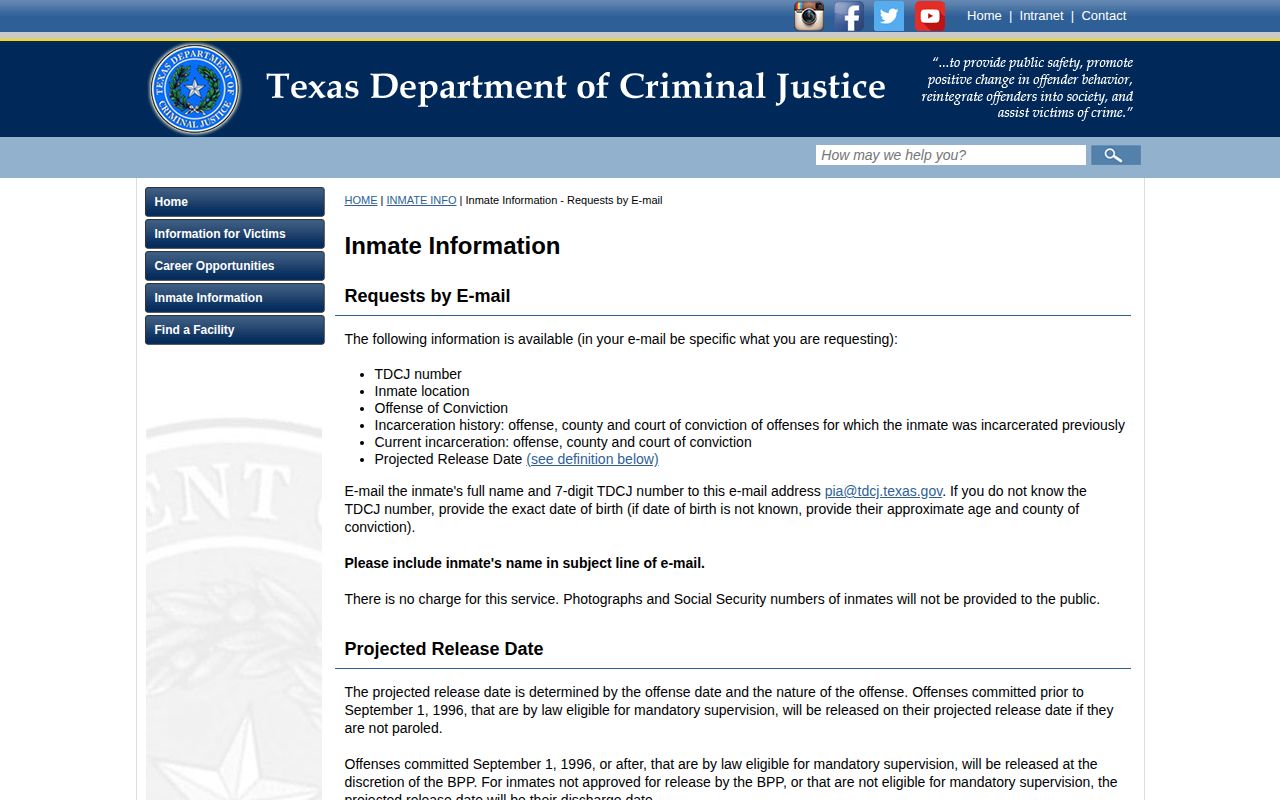
The captured definition supports reading the field as a conditional forecast rather than a guaranteed gate date.
Parole-in-absentia is a narrow exception for a person physically in county jail. TDCJ says those dates may not be posted through the ordinary online calculation route. Use Camp Jail and state parole-review contacts instead of treating the blank field as denial or discharge.
Request Camp Release-Date Records
When a live TDCJ result does not resolve a date, use the no-charge inmate-information email before ordering a larger record set. For a formal request, TDCJ provides an online Public Information Act form, PIA@tdcj.texas.gov, and a mailing route to TDCJ Public Information Request, PO Box 4017, Huntsville, TX 77342. Hand delivery goes to 2 Financial Plaza, Suite 600, Huntsville, TX 77340. Ask for existing records rather than a new legal calculation.
A narrow state request can name the release certificate, actual release or discharge date and type, incarceration history, public time sheet, judgment data, and applicable public fields under Government Code Section 552.029. TDCJ's posted charge explanation says requests below 50 pages generally cost ten cents per page plus postage. Larger requests can add labor and overhead, and the agency supplies an itemized estimate when its estimate exceeds $40. These are TDCJ charges, not a Camp County Sheriff fee.
Government Code Section 552.029 identifies public TDCJ categories that include the inmate identifier, unit and receipt date, conviction offense, judgment and sentence, convicting county and court, earliest and latest possible release dates, parole date or earliest parole date, and prior confinement. The standard email and formal request routes deliver different sets of information. If a result appears wrong, attach the authoritative judgment or credit order and identify the exact field instead of asking TDCJ to explain a broad discrepancy.
Camp Parole Dates Need Processing
A favorable parole vote is one step in a longer state process. TDCJ Review and Release Processing validates the release plan and conditions, completes a record audit, prepares the release certificate, and coordinates scheduling. A program-linked approval takes more time because the required program must be completed. The office lists 8610 Shoal Creek Boulevard, Austin, TX 78757 and 512-406-5449.
The useful sequence is eligibility, file review, panel vote, validation and scheduling, then physical release. A final sentence discharge can occur later. For Camp-area supervision, the Mount Pleasant District Parole Office becomes relevant after state release. Neither the office assignment nor a favorable code proves the person crossed the release gate. Preserve the original decision code, call the phone line that matches the stage, and seek the actual status entry.
Read Camp Release-Date Scenarios
A Camp bond case has no TDCJ projected date. The jail may book the person out after bond is accepted, but the criminal case remains pending and another cause can keep the person held. Confirm the community book-out with the Sheriff and read the clerk docket for the bond entry. Do not describe the bond date as sentence completion or dismissal.
After a Camp-to-TDCJ transfer, the county release field records exit from Camp custody, not freedom from incarceration. The state result may take time to appear during intake. Once TDCJ processes the person, its projected, eligibility, location, and status fields become the relevant state record. Keep the Camp transfer time and later state calculation as two events in one custody chain.
A Board approval with a program-linked code still leaves the person in prison until the program, plan, audit, certificate, and scheduling steps are complete. A scheduled release location can appear after that work advances, yet the date can change through release day. Only the later TDCJ status, release certificate, or direct release-processing confirmation shows that physical release occurred.
Finally, a detainer can change the destination without erasing the release event from the first custodian. Camp may book someone out to another county, TDCJ, or ICE. TDCJ can also release a person who then enters another agency's custody. Ask for the receiving agency whenever the record says transfer, and continue the search in that system instead of treating the first date as community release.
Public Record Search
Sponsored Results