
Where Camp Jail Releases Go
Camp County Jail is a county jail operated by the Camp County Sheriff’s Office at 203 Tapp Street in Pittsburg. A person may return to the community after bond, a personal bond, completion of a county sentence, a dismissal-related order, or another lawful discharge. The facility may instead relinquish custody to the Texas Department of Criminal Justice, another county, an agency holding a warrant, the United States Marshals Service, or U.S. Immigration and Customs Enforcement.
The phrase “released from Camp County Jail” therefore identifies the end of one custodian’s hold. It does not establish unrestricted freedom. Ask for the book-out timestamp, the release code or type, any remaining hold, and the receiving agency. When another agency took custody, use that agency’s locator or record system next.
A bond notation also needs careful reading. Bond is a pre-disposition release conditioned on appearance, not acquittal or dismissal. Time served or sentence expiration means the custodial portion credited by the jail ended. A transfer means Camp custody ended while confinement continued elsewhere. Preserve the record’s original language instead of reducing different events to a single generic release label.
Confirm a Camp Jail Release
The official Camp County path combines VINELink, direct Sheriff confirmation, and a written record when exact evidence matters. Use more than a name whenever possible because people can share names and interactive records can change.
- Open Texas VINELink and search for the matching Camp County custody record using the available name or identifier fields.
- Compare the agency, identifier, and identifying details. Record the returned custody wording and event time exactly.
- Call the Sheriff’s Office at 903-856-6651. Provide the full name, date of birth if known, and approximate booking date.
- Ask whether the person is presently held for Camp County, housed at 203 Tapp Street or elsewhere, finally booked out, released to the community, or transferred.
- Ask whether another hold remained and whether staff can identify a receiving agency.
- When the timestamp or release category must be documented, make a narrow written request for the existing booking and release fields.
- Read the proper court file for the bond, dismissal, judgment, sentence, or other legal event. A docket does not replace the jail’s physical book-out record.
The official Sheriff page confirms the agency contact and its VINELink direction.
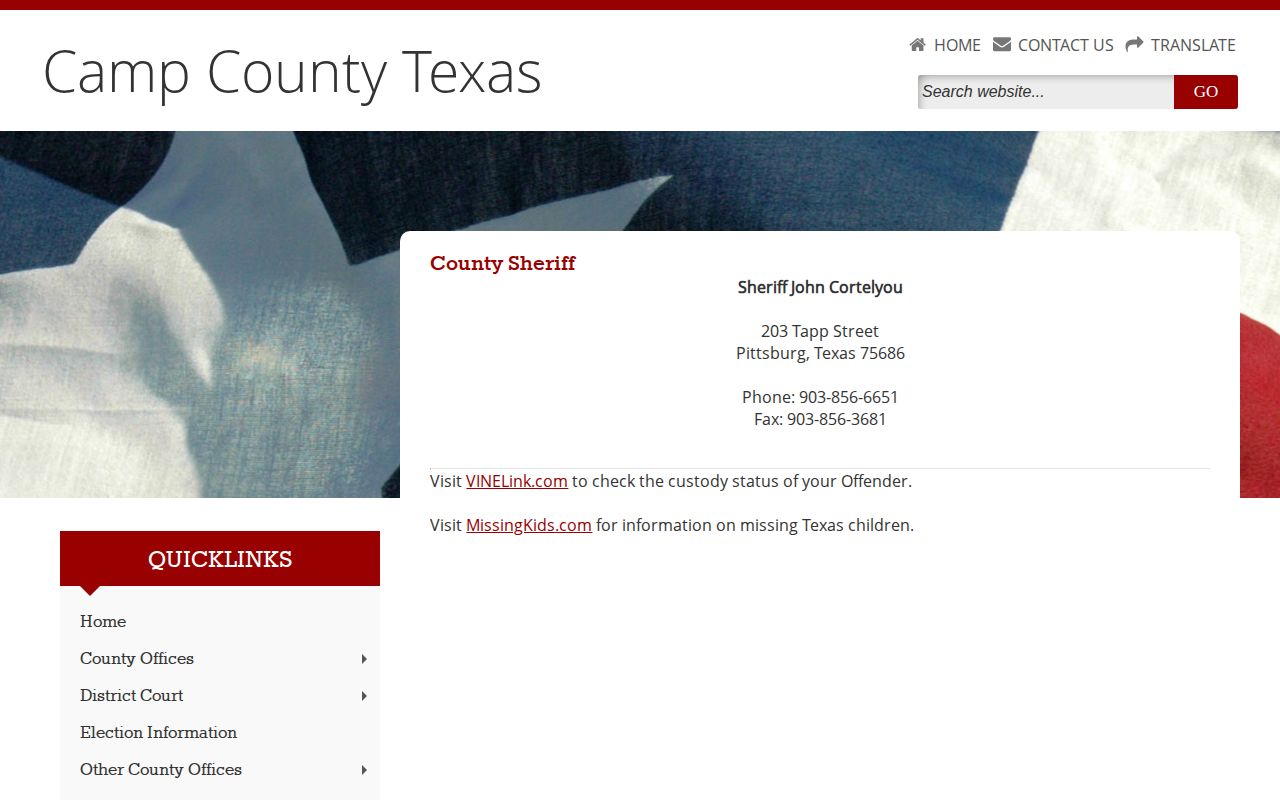
This official page establishes the correct local starting point, but it does not display a roster, release date, release reason, or historical archive. A missing online result is not a release certificate.
Jail Records and Contact
Camp County Jail / Sheriff’s Office
203 Tapp Street
Pittsburg, Texas 75686
Phone: 903-856-6651
Fax: 903-856-3681
Sheriff: John Cortelyou
Camp County publishes no dedicated Sheriff records-request form, electronic submission route, records-unit hours, local copy fee, release-lobby instructions, or record-retention period. Call before visiting to confirm the current custodian, accepted delivery method, hours, and any estimated charge. Do not assume public records service is available at all times merely because detention operations continue around the clock.
For a precise release record, request existing documents and fields rather than asking the agency to research or explain the event. Include the person’s full name, date of birth if known, approximate booking and release dates, and cause or booking number if available. Request the booking sheet; book-in and book-out date and time; release type or reason; an existing code legend if the reason is abbreviated; bond or release notation; receiving agency or transfer destination; and booking photograph.
Texas Government Code Chapter 552 does not guarantee that every requested item will be released without redaction. Active-case interests, confidential identifiers, juvenile law, court orders, privacy protections, and law-enforcement exceptions may apply. The familiar ten-business-day period concerns steps an agency takes when seeking an Attorney General decision to withhold information, not a promise that every request will be completed within ten days. Ask for a cost estimate and narrow an expensive request.
About Camp County Jail
The facility is the primary county jail confirmed inside Camp County and is operated by the Sheriff’s Office. It handles Camp County custody episodes rather than serving as a TDCJ state prison, federal Bureau of Prisons institution, or ICE detention center. No official county web roster, 24-hour list, 72-hour list, release archive, booking-photo gallery, or Sheriff mobile app was confirmed as of the August 2, 2026 research date.
The jail’s record answers a county custody question. It should not be replaced with a TDCJ projected release date, which applies within the state-prison process. County jail credit and possible Sheriff good-conduct commutation arise under a different legal framework, including Texas Code of Criminal Procedure Article 42.032. A projected state date does not control the timing of a Camp County bond release.
The Camp County Clerk handles county-level records and offers the county public-search route, while the District Clerk handles district and felony cases. Court records can show the charge, bond, plea, judgment, sentence, dismissal, or orders. They may explain why a release occurred but may not show the exact minute the person physically left the jail.
Out-of-County Housing Changes the Route
Camp County’s adopted budget documents a spending category for housing inmates outside the county. This supports the existence of out-of-county housing as a county practice, but it does not identify where any particular person was confined. The Sheriff’s Office may remain the initiating or responsible county contact while another jail physically holds the person.
Ask whether the person is housed elsewhere, which agency has physical custody, whether Camp entered a release, and whether a second hold remains. If another facility performed the eventual physical release, confirm its book-out record as well as the Camp booking. Do not infer a receiving jail from the budget or treat absence from a local channel as proof that the person left custody.
This distinction is especially important when reconstructing an older event. VINELink is oriented to custody events and notifications, not a permanent historical archive. A written Camp booking record, the physical custodian’s release entry, and the relevant court case form a stronger chain than a collection of current “no result” screens.
ICE Handoffs After Book-Out
An ICE detainer can result in a Camp book-out followed by immigration custody rather than community release. ICE describes a detainer as a request that another agency notify ICE and maintain custody for up to 48 hours beyond the time the person otherwise would be released so ICE may assume custody. The person-specific record controls whether a handoff occurred.
The ICE detainer explanation shows why the county release field and the next custodian must be read together.
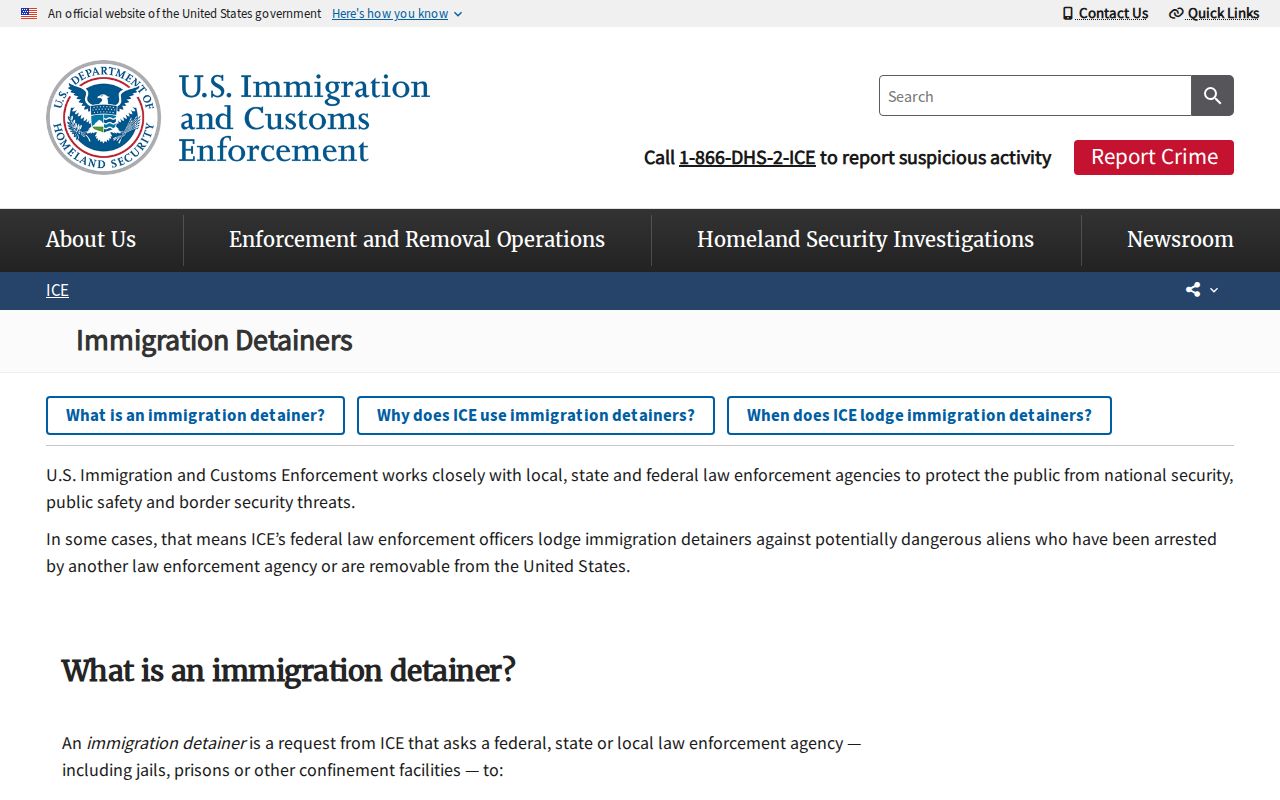
This federal explanation provides transfer context, but it does not prove that ICE acted in a particular Camp County case. Ask the Sheriff for the receiving-agency field, then use the ICE Online Detainee Locator promptly when the custody chain supports immigration involvement.
ICE’s locator accepts a nine-digit A-number with country of birth, or exact name with country of birth and optional date of birth. It includes current detainees and people released from ICE custody within a stated 60-day window. A county book-out and an ICE result describe separate custody stages and should remain separate in any timeline.
January 2026 Facility Notice
The Texas Commission on Jail Standards issued a January 14, 2026 noncompliance notice following a January 8 inspection concerning missed medication doses. The notice confirms the facility’s formal identity and provides recent operational context. It says nothing about a particular person’s book-out, release type, transfer, bond, or custody status.
Facility-wide inspection information must not be used as individual release evidence. A person-specific conclusion still requires the jail or reporting agency’s custody event, direct confirmation, and the relevant record. The notice also does not establish release timing, a public waiting area, property-return procedures, transportation options, or which door a person uses when leaving.
When Another System Takes Over
A transfer to TDCJ ends Camp jail custody without ending incarceration. Wait for state intake processing, then use the TDCJ offender search with the TDCJ or SID number when available. Read projected, scheduled, parole, release, and discharge fields exactly. A projected date is a calculation, while an actual release or discharge entry addresses a later event.
A federal defendant may be held under United States Marshals Service authority and later delivered to BOP, released by court order, or transferred. BOP’s locator covers federal prison records, not every person held pretrial for USMS. A past BOP Release Date with Location “RELEASED” means the person left BOP custody, not that supervised release ended or every other hold cleared.
Use the home search path only after classifying the custody episode. A routine Camp bond release belongs in the Sheriff, VINELink, and local court chain. TDCJ, BOP, and ICE become relevant only when the record identifies state, federal, or immigration custody. This prevents a county-jail question from being sent into the wrong database.
Release Record Limits
There is no single universal release record. Useful Camp County evidence may consist of a booking sheet, jail-management release entry, bond notation, release reason, receiving-agency field, property record, or agency response. Ask for the specific items needed to answer the custody question and preserve the original terminology.
A disappearance from an online result is negative evidence only. It may reflect release, transfer, delayed data, spelling mismatch, a new identifier, a sealed record, or a system outage. No official source states how long a Camp booking remains searchable because the county publishes no release archive. Administrative retention schedules also do not promise public web access.
When the public record is sealed, expunged, withheld, or unavailable, report the limitation and contact the appropriate custodian or clerk. Do not reconstruct confidential details from cached pages or treat absence as evidence of guilt, innocence, custody, or release.